Why Your Brain Loves Easy (And Why That's a Good Thing)

"If my brain loves easy... does that mean I'm just lazy?"
It's a question many of us ask ourselves.
Why do I put off simple jobs?
Why do I ignore emails?
Why does choosing dinner sometimes feel harder than writing a report?
Why do I leave wet washing in the washing machine for three days even though it would only take ten minutes to hang out?
The answer probably isn't laziness.
In fact, your brain is doing exactly what it evolved to do.
The problem is that it evolved for a very different world.
Your brain isn't looking for the hardest option. It's looking for the safest option for the least amount of effort.
🧠 Your brain is surprisingly expensive to run
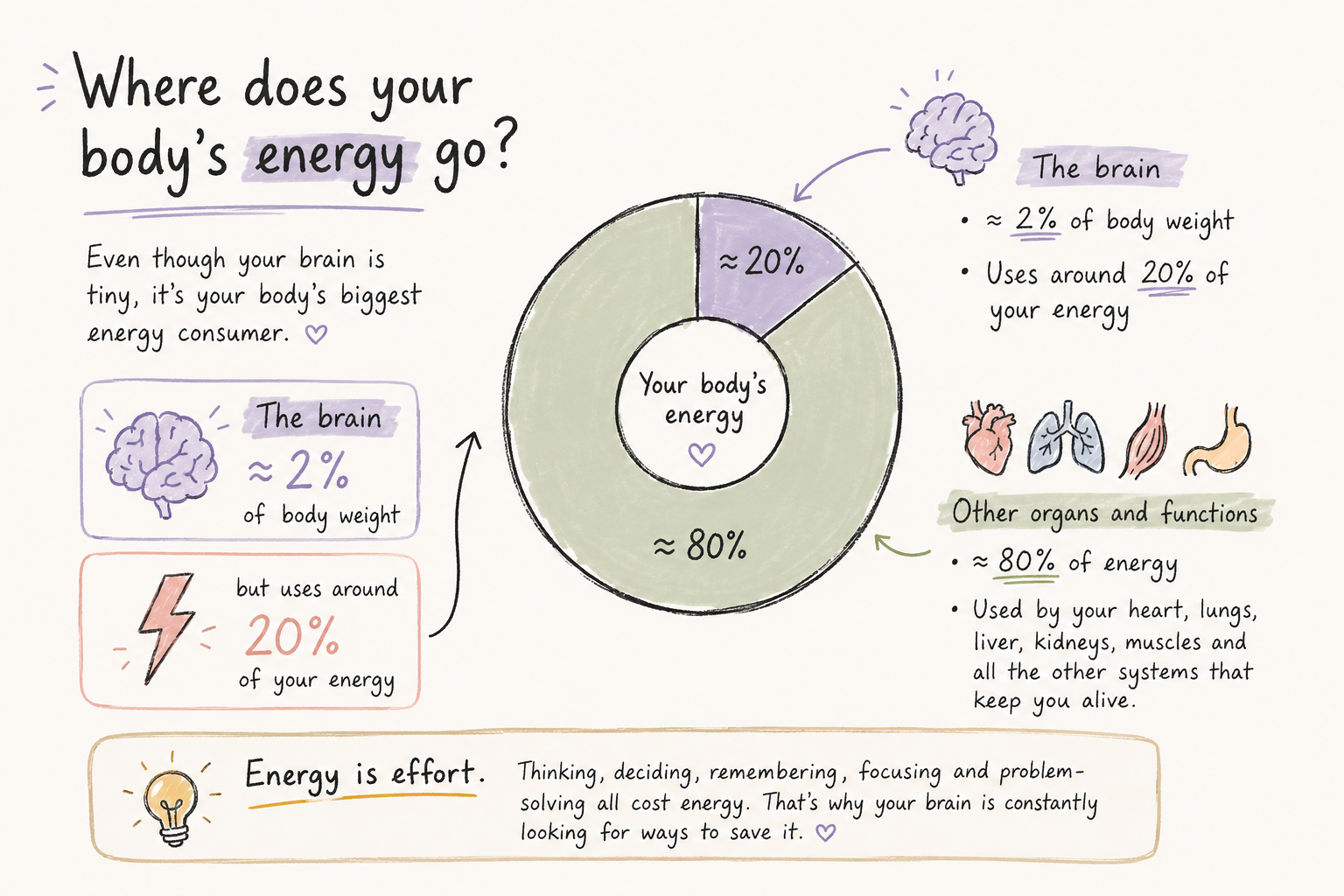
Although your brain only makes up around 2% of your body weight, it uses roughly 20% of your body's energy.
That's a huge amount.
Even when you're sitting completely still reading this article, billions of brain cells are communicating with one another.
They're:
Predicting
Filtering
Planning
Remembering
Ignoring
Prioritising
Your brain is constantly asking one question:
"How can I get the best outcome while using the least amount of energy?"
That isn't a flaw.
It's remarkably efficient.
⚡Where your body's energy goes
🌍 Your brain wasn't designed for modern life
For most of human history, your ancestors didn't need to remember:
sixteen passwords
school emails
loyalty cards
two-factor authentication
what was for dinner
when the car insurance renews
twenty WhatsApp conversations
which streaming service has that programme
where they left their phone
Their brains solved very different problems.
Finding food.
Avoiding danger.
Looking after other people.
Building relationships.
Today's world asks your brain to do all of that... plus thousands of tiny decisions every single day.
It's no wonder so many people feel mentally exhausted before lunchtime.
The problem isn't that your brain has changed. The world has.
⚡ Your brain is constantly trying to save effort
Imagine you're carrying six shopping bags.
Someone offers to carry two.
Would you refuse?
Of course not.
Your brain feels exactly the same about mental effort.
Every unnecessary decision.
Every repeated task.
Every forgotten appointment.
Every complicated form.
They're all extra shopping bags.
So your brain naturally looks for shortcuts.
Sometimes that's helpful.
Sometimes it means procrastinating.
Sometimes it means choosing the same lunch every day.
Sometimes it means putting off something that feels mentally expensive.
Not because you don't care.
Because your brain is protecting the energy it has left.
Your brain isn't avoiding the task. It's avoiding the effort it thinks the task will require.
📖 In Plain English
Psychologists sometimes describe this as cognitive effort.
In simple terms... it's how much mental work something feels like it will take.
Interestingly, that feeling isn't always accurate.
A five minute task can feel enormous if you're already mentally overloaded.
🏡 Why this matters in everyday life
This is where occupational science gives us such a helpful perspective.
Occupational science is the study of the everyday things people do and why they do them.
It recognises that every activity has a cost.
Not just time.
Not just money.
But physical effort. Mental effort. Emotional effort.
When those costs become too high, people naturally start adapting.
Sometimes those adaptations are helpful.
Sometimes they aren't.
You might stop cooking and order takeaway
Leave letters unopened
Avoid booking appointments
Keep putting off that form
Not because you don't know they're important.
Because your brain is trying to manage limited resources.
Understanding that changes the question completely.
Instead of asking:
"Why am I so lazy?"
You begin asking:
"What's making this feel so hard?"
That's often a much more useful place to start.
Behaviour always makes more sense when you understand the effort behind it.
🤖 This is why AI feels so helpful
This is one of the reasons AI has become so popular.
Not because people suddenly don't want to think.
But because AI can remove unnecessary thinking.
AI won't brush your teeth.
It won't go for your walk.
It won't have difficult conversations for you.
But it can help with the invisible work that often fills our heads.
Things like:
summarising long emails
turning messy notes into clear plans
generating meal ideas
organising information
explaining confusing letters
creating first drafts
breaking overwhelming tasks into manageable steps
None of those replace your brain.
They simply free it up to focus on the things only you can do.
Think less about replacing your brain. Think more about giving it a helpful assistant.
🌱 Designing a life that works with your brain
For years, productivity advice has focused on squeezing more out of ourselves.
Wake up at 5am (no thank you).
Be more disciplined.
Push harder.
Optimise everything.
But what if the goal isn't to become better at carrying heavy mental loads?
What if the goal is simply to carry less?
That might mean:
using reminders instead of relying on memory
creating routines instead of making repeated decisions
keeping meals simple during busy weeks
writing things down instead of trying to remember them
asking AI to organise your thoughts
saying no to things that create unnecessary mental clutter
These aren't signs of weakness.
They're examples of designing your environment to support your brain instead of constantly testing it.
✨ Key takeaway
Your brain loves easy because easy uses less energy.
That's not laziness.
It's biology.
The challenge isn't to fight your brain.
It's to build a life where your brain doesn't have to fight quite so hard every day.
🎯 Try this today
Instead of asking yourself:
"How can I be more disciplined?"
Try asking:
"How could I make this easier?"
You might be surprised how often the answer is simpler than you expected.
📚 Explore further
📖 Read next
Why Everything Feels So Overwhelming (And What You Can Do About It)
The Hidden Cost of Decision Fatigue
Why Willpower Isn't the Problem
How to Make Everyday Life Easier
🛠️ Tools I recommend
ChatGPT – for reducing mental effort and organising ideas.
Goblin Tools – for breaking overwhelming tasks into manageable steps.
Google Keep or Apple Reminders – for getting things out of your head.
📚 Trusted sources
NHS Every Mind Matters - Practical, evidence-based advice on managing stress, improving sleep and supporting your mental wellbeing.
British Psychological Society - Trusted information about psychology, behaviour and mental health from the UK's professional body for psychologists.
The Extended Mind by Annie Murphy Paul – Explores how our thinking is shaped not just by our brains, but by our bodies, surroundings and relationships.
The Organized Mind by Daniel Levitin – Explains why modern life overwhelms our brains and how we can work with, rather than against, our cognitive limits.
Thinking, Fast and Slow by Daniel Kahneman – A classic exploration of how we make decisions and why our brains often rely on mental shortcuts.
