Why Everything Feels So Overwhelming (And What You Can Do About It)

"What do you want for lunch?"
It's one of the simplest questions someone can ask.
Most days, I'd answer without thinking.
But one day, I couldn't.
I wasn't upset about lunch. Nothing terrible had happened. I wasn't even particularly hungry.
I just couldn't make one more decision.
At the time, I remember thinking, “what's wrong with me?”
Looking back, I realise I was asking the wrong question.
The better question was this:
What was my brain trying to tell me?
Because overwhelm rarely appears out of nowhere.
It quietly builds.
One more responsibility.
One more email.
One more appointment to remember.
One more person who needs something from you.
One more decision.
Eventually, your brain reaches a point where even something as ordinary as deciding what to cook feels impossible.
If you've ever stood in Tesco staring at two perfectly acceptable options of baked beans and wondered why you suddenly felt like crying, you're not alone.
The decision probably wasn't about the baked beans.
It was everything that came before them.
🪫Your brain has a limited amount of mental capacity
Most of us understand physical energy.
If you've spent the day moving house, you'll expect to feel physically tired.
Mental energy works in a similar way.
Your brain is constantly processing information. It pays attention to what's happening around you, filters out distractions, remembers important information, plans ahead, solves problems and helps you make decisions. Much of this happens automatically, without you even noticing.
Although your brain is incredibly powerful, it isn't limitless.
Psychologists often talk about cognitive load, which describes the amount of mental effort your brain is using at any given time.
Imagine your mind as a desk.
At the start of the day, it's relatively clear.
As the day goes on, things begin to pile up.
An email you need to reply to.
A prescription that needs collecting.
A birthday you've remembered at the last minute.
The washing that still hasn't been folded.
The conversation you keep replaying in your head.
A work deadline.
A family member you're worried about.
None of those things takes up much space on its own.
Together, they begin to cover the entire desk.
The more cluttered the desk becomes, the harder it is to find room for the next task.
Your brain works in much the same way.
The challenge isn't usually one big problem.
It's lots of small demands competing for the same limited mental resources.
🤔Why simple decisions suddenly become difficult
"Your brain isn't struggling with the baked beans. It's struggling with everything else."
One of the first things people notice when they're overwhelmed is that simple decisions start feeling surprisingly difficult.
You know you need to choose something for dinner.
Reply to a message.
Book an appointment.
Fold the washing.
None of those tasks is particularly complicated.
So why do they suddenly feel so much harder?
Part of the answer lies in something called working memory.
Working memory is the system that allows us to temporarily hold and use information. We rely on it whenever we're following instructions, solving problems, planning what to do next or keeping track of several pieces of information at once.
The important thing to know is that working memory has a limited capacity.
It was never designed to keep track of dozens of unfinished tasks, constant notifications and an endless stream of decisions.
When working memory becomes overloaded, everyday life starts to feel heavier.
You might read the same email three times before taking it in.
Forget why you walked upstairs.
Walk into a room and lose your train of thought.
Or stare at two tins of baked beans wondering why your brain has stopped cooperating.
It hasn't.
It's simply reached its limit.
⚠️Stress changes the way we think
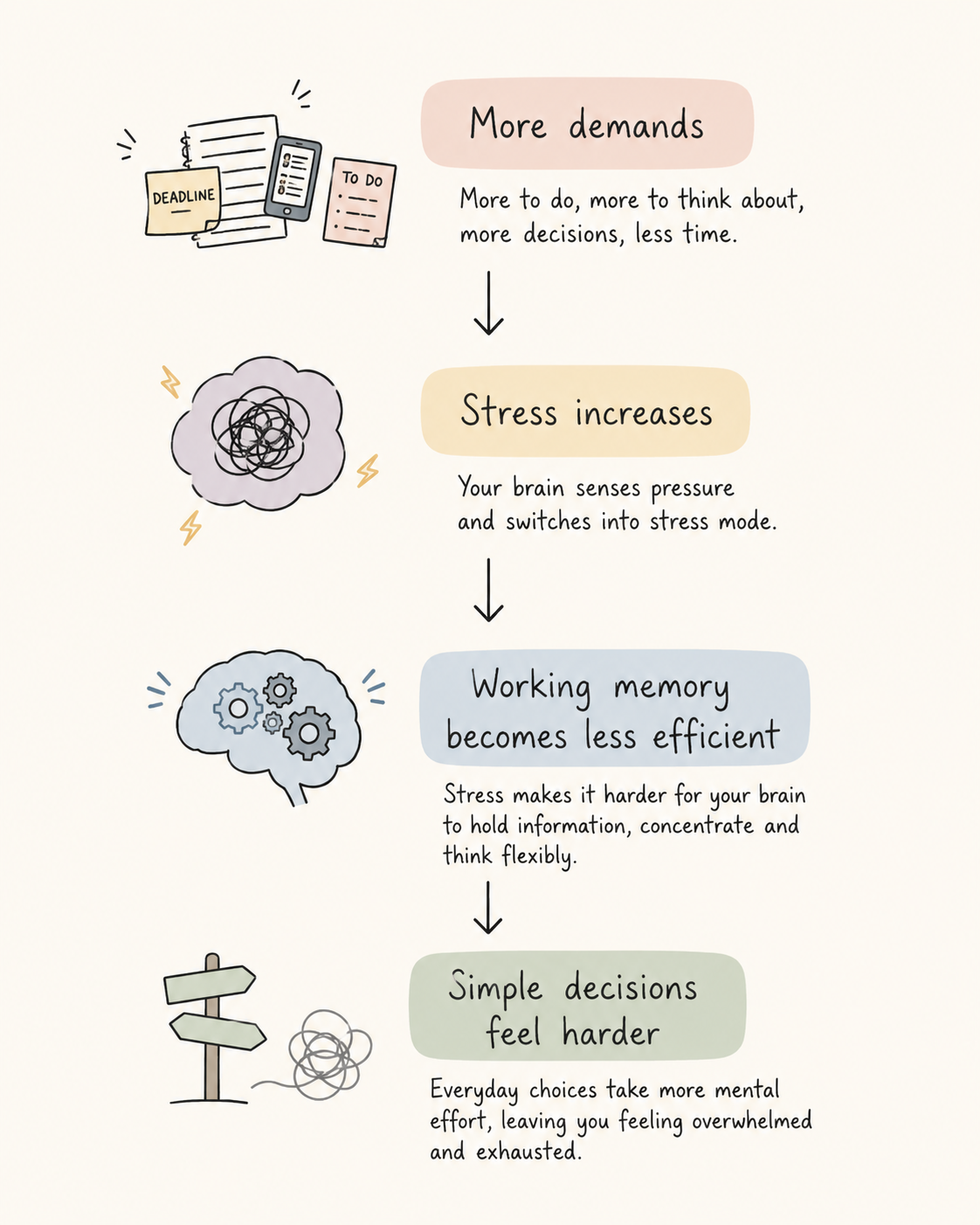
When we're under pressure, our brains don't stop working.
They work differently.
Stress is often described as the body's response to situations that feel demanding or challenging. In the short term, this response can be helpful. It prepares us to react quickly when something needs our attention.
The problem comes when those demands don't switch off.
Financial worries.
Poor sleep.
Caring responsibilities.
Work pressures.
Health concerns.
Uncertainty about the future.
Instead of dealing with one short-lived challenge, your brain is trying to manage many ongoing ones.
Research has consistently shown that stress can reduce performance on tasks involving working memory, attention and cognitive flexibility. These are the very skills we rely on to organise our lives, make decisions and adapt when plans change.
This helps explain why you can be perfectly capable of managing a complex project at work, yet feel completely overwhelmed by deciding what to cook on a Wednesday evening.
The issue isn't intelligence.
It's available mental capacity.
📋Why "just get organised" isn't always helpful
When people feel overwhelmed, they're often given well-meaning advice.
Buy a planner.
Manage your time better.
Be more organised.
While those suggestions can help, they sometimes miss the bigger picture.
Imagine someone asking you to carry ten shopping bags from your car.
Halfway to the front door they hand you an eleventh bag.
Then they say, "You just need a better way of carrying them."
A different technique might help a little.
But the real problem is the weight you're carrying.
Life works in much the same way.
Sometimes we genuinely need better systems.
Other times, we need life to ask a little less of us.
Recognising the difference is important.
📱Modern life asks a lot of our brains
Our brains evolved in environments that were very different from the world we live in today.
Now we navigate hundreds of decisions every day.
We switch between conversations, emails, shopping lists, calendars, news updates and social media, often within the same hour.
Our attention is constantly being pulled in different directions.
Every interruption asks your brain to stop one task, remember where it got to and begin another. That process has a mental cost.
It isn't surprising that so many people describe feeling mentally exhausted before they've even finished the day.
This doesn't mean technology is bad.
It simply means our brains benefit from having fewer unnecessary demands placed on them.
🧩So what actually helps?
There isn't one solution because overwhelm rarely has one cause.
Instead, the aim is to reduce the amount of unnecessary work your brain has to do.
One of the most effective ways to do this is to stop expecting your brain to remember everything.
Write things down.
Use reminders.
Keep a simple running list.
Externalising information reduces the burden on your working memory and allows your brain to focus on thinking rather than remembering.
It also helps to reduce the number of decisions you make repeatedly.
You don't need to plan every meal for the next month.
But having a handful of go-to breakfasts or a regular food shop can remove dozens of small decisions over time.
This is one of the reasons habits are so powerful.
Once a behaviour becomes familiar, your brain no longer has to make the same decision from scratch every day.
It simply follows a well-practised pattern.
I've also found AI incredibly helpful.
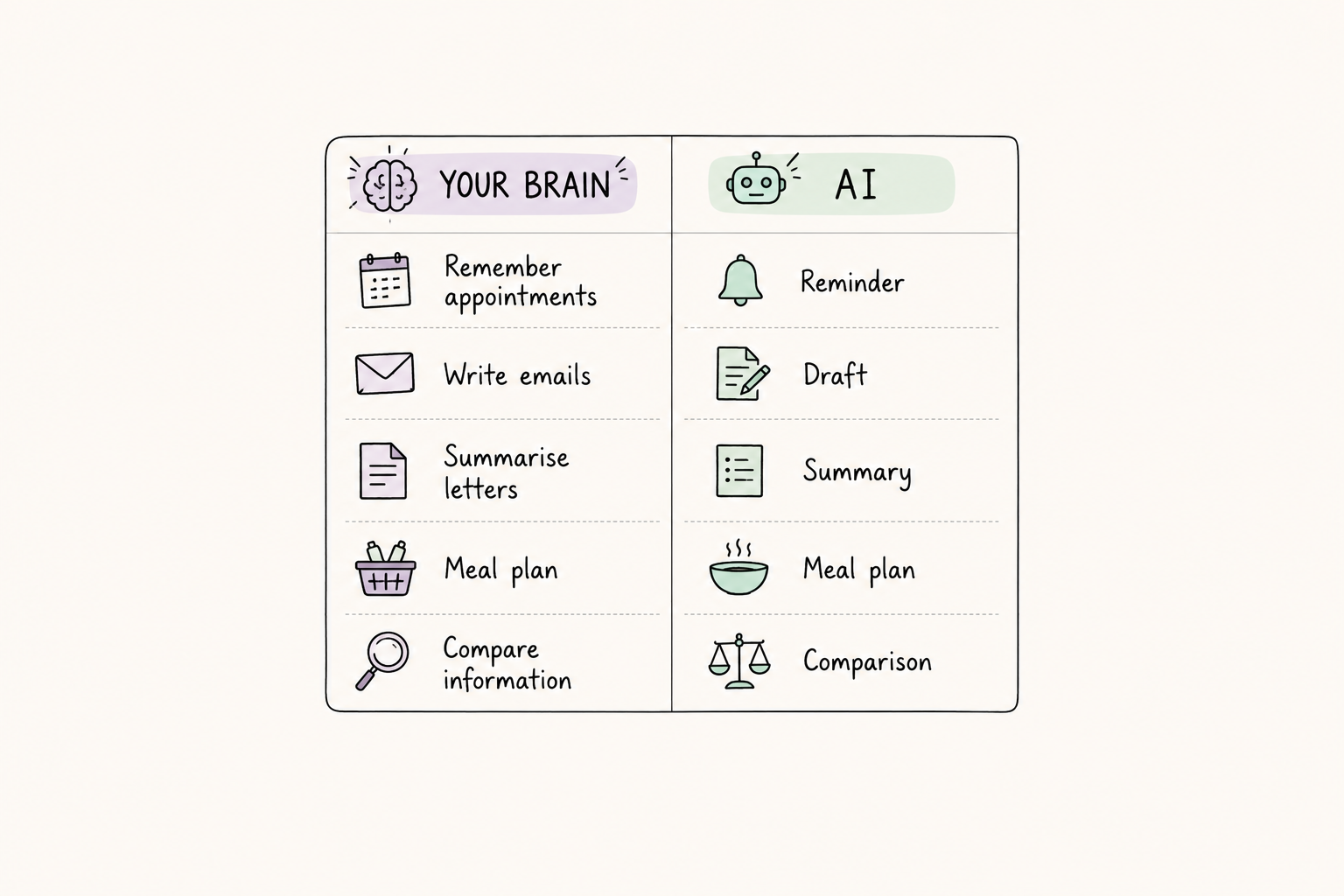
Not because it replaces thinking.
Because it removes unnecessary thinking.
I use it to summarise long documents, organise ideas, draft difficult emails and break large projects into manageable steps.
Used well, it acts like an extra pair of hands for your brain.
The goal isn't to become dependent on technology.
The goal is to spend less mental energy on low-value tasks, so you have more available for the things that matter.
🧠The question I ask myself now
These days, when I start feeling overwhelmed, I rarely ask:
"How can I work harder?"
Instead, I ask:
"How can I make this easier?"
It's a small change in language, but it often leads to very different answers.
Maybe I don't need to remember everything.
Maybe I don't need to make every decision today.
Maybe I don't need to do it alone.
Maybe the task is simply too big and needs breaking down.
Maybe I'm expecting my brain to carry more than it realistically can.
Sometimes the answer is practical.
Sometimes it's asking for help.
Sometimes it's getting an early night.
Sometimes it's accepting that this isn't the day to make a big decision.
💡 Try this today
Ask yourself one question:
"What could I make easier today?"
Not "What else should I do?"
Not "How can I be more productive?"
Just one thing that reduces the load on your brain.
It could be:
Setting a reminder instead of trying to remember.
Ordering your usual food shop.
Asking AI to draft an email.
Wearing the same outfit you always wear on Mondays.
Deciding tomorrow's breakfast tonight.
Small changes don't remove every demand from life.
