Why Does Everything Feel So Hard?

Have you ever looked around and wondered how everyone else seems to be keeping up?
People appear to be working, exercising, cooking healthy meals, replying to messages, looking after children, seeing friends, managing money and somehow still finding time to relax. Meanwhile, you're staring at a pile of washing, avoiding an email you've been meaning to answer for days and wondering why even simple tasks feel exhausting.
If that sounds familiar, you're far from alone.
Feeling like everything is harder than it should be is one of the most common experiences people have, yet it's often misunderstood. Many people assume they are lazy, unmotivated or simply "not trying hard enough."
The evidence suggests something very different.
Your brain, body and daily environment all influence how difficult life feels. When they become overloaded, even small jobs can require far more effort than they normally would.
The good news is that feeling overwhelmed is not usually a sign that something is wrong with you. More often, it is a sign that something needs to change around you.
😓 The problem
Almost every task in modern life asks something of your brain.
Making breakfast means making decisions.
Checking your phone means filtering information.
Answering an email means concentrating.
Planning dinner means remembering what's in the fridge, deciding what to cook, checking time, thinking about nutrition and working out whether you have enough energy.
None of these tasks seem particularly difficult on their own.
The problem is that they rarely happen on their own.
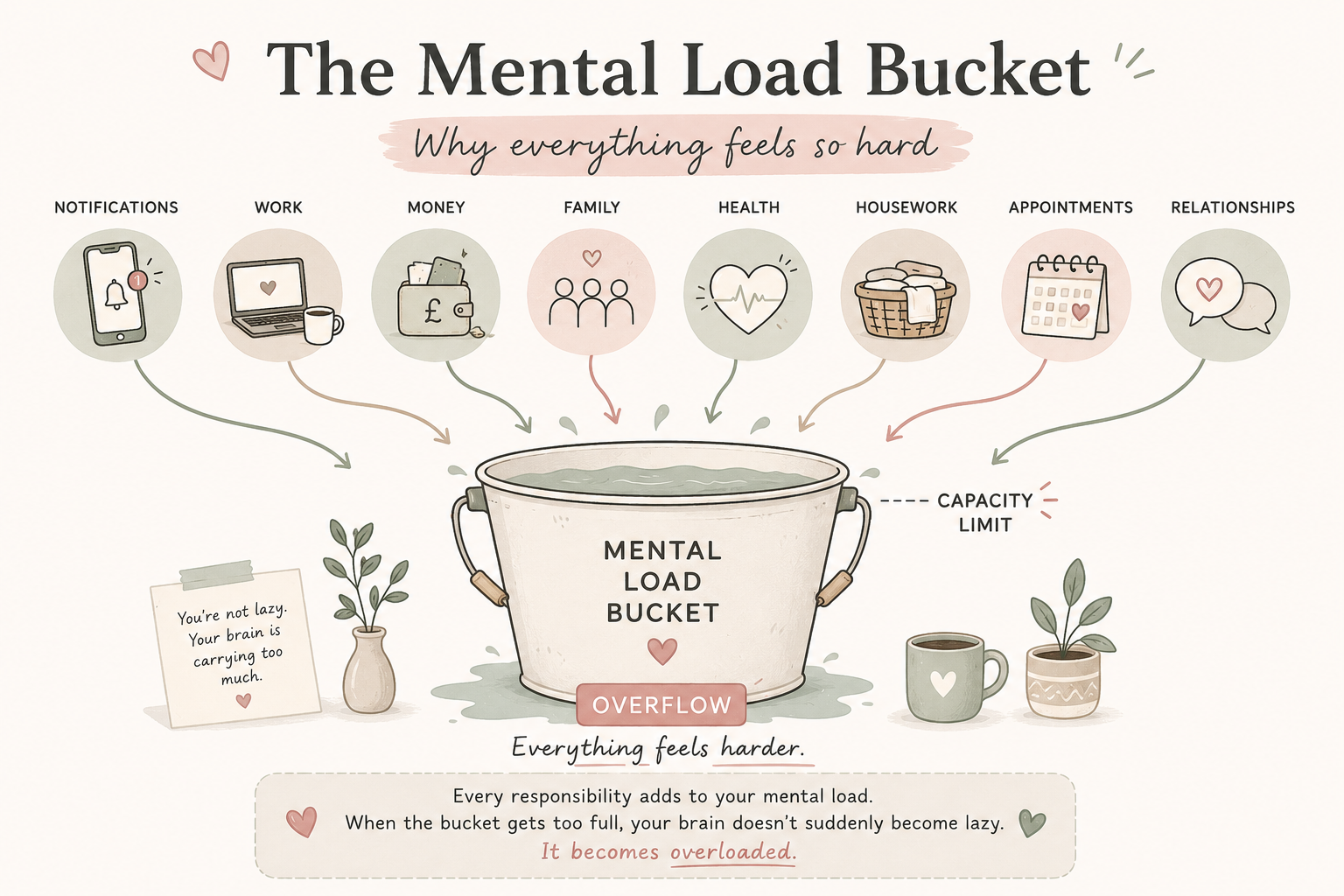
Your brain is constantly switching between work, family, finances, household jobs, health, notifications and unexpected interruptions. By the end of the day it can feel as though you've been solving hundreds of tiny problems without even realising it.
Occupational science, the study of how people spend their time and energy in everyday life, recognises that every activity has a cost. Some activities demand physical effort, others demand mental effort, emotional effort or social effort. Most everyday tasks involve all four.
This means that life can become difficult long before you've done anything particularly dramatic.
Someone caring for ageing parents, working full time, managing a health condition or raising young children may appear to be "doing normal life," yet their brain is processing an enormous amount behind the scenes.
When enough of these demands build up together, everything begins to feel harder.
🧠 Why it happens
Your brain has a limited amount of mental energy
Your brain is incredibly powerful, but it is not unlimited.
The areas at the front of the brain help you plan, organise, solve problems, make decisions, focus attention and control impulses. Psychologists often call these executive functions.
These systems work brilliantly when demands are manageable.
When demands become too high, they become less efficient.
That is why you can spend twenty minutes looking for your phone while it's in your hand, forget why you walked upstairs or find yourself unable to decide what to eat for dinner.
This is not because you've suddenly become incapable.
Your brain is prioritising survival over efficiency.
Decision fatigue is real
Research shows that making repeated decisions throughout the day can make later decisions feel more difficult.
Even small choices require mental effort.
What should I wear?
Should I reply now or later?
What should we have for dinner?
Do I exercise today or tomorrow?
One decision is easy.
Two hundred decisions are not.
This is why many people feel surprisingly exhausted without having done anything physically demanding.
Stress changes how your brain works
When you're under pressure, your brain shifts its priorities.
Instead of focusing on long term planning and careful thinking, it becomes more focused on spotting problems and dealing with immediate challenges.
This response is helpful during genuine emergencies.
It is much less helpful when the "emergency" is an overflowing inbox, unpaid bills and twenty unfinished jobs around the house.
Chronic stress can reduce concentration, affect memory, increase mental fatigue and make ordinary tasks feel much bigger than they really are.
Modern life is mentally demanding
Our brains evolved in environments that looked nothing like today's world.
We now receive hundreds of notifications, endless news updates, constant advertising, social media comparisons and unlimited choices every day.
Your attention is one of the most valuable things you own.
Unfortunately, many companies compete for it constantly.
The result is that your brain rarely gets the chance to fully recover.
Poor sleep makes everything harder
Sleep is when your brain clears waste products, strengthens memories and restores many of the systems involved in thinking and emotional regulation.
Even one poor night's sleep can reduce attention, increase emotional reactions and make everyday tasks feel more difficult.
If you're already carrying a heavy mental load, poor sleep often magnifies it.
Your environment matters more than you think
Occupational science reminds us that people do not exist in isolation.
The environments we live and work in influence what we are able to do.
If your house is cluttered, your workspace is noisy, your phone interrupts you every few minutes or every surface reminds you of another unfinished job, your brain must process all of that information.
Reducing unnecessary demands on your environment often reduces mental effort far more effectively than trying to become more motivated.
❌ Common myths
"I'm just lazy."
Laziness is often used to explain behaviour that actually has many possible causes.
Stress, poor sleep, illness, burnout, depression, anxiety, chronic pain, caring responsibilities, decision fatigue and cognitive overload can all reduce someone's ability to start or complete tasks.
Assuming laziness is the problem often creates guilt without solving anything.
"I just need more motivation."
Motivation is unreliable.
It naturally rises and falls depending on sleep, stress, health, mood and countless other factors.
People who consistently get things done are often relying less on motivation than they are on routines, habits and environments that make the right choice easier.
"Everyone else is coping."
Social media rarely shows unfinished laundry, cancelled plans, difficult conversations or overwhelming days.
Many people who appear highly organised have simplified parts of their lives in ways you never see.
Comparing your behind the scenes to someone else's highlights almost always leads to unfair conclusions.
"I need to try harder."
Trying harder works for some problems.
It is rarely the best solution for overload.
If your backpack already weighs 30 kilograms, carrying it with more determination does not make it lighter.
Reducing the load is usually more effective than increasing the effort.
✅ Practical solutions
Reduce decisions wherever possible
Every decision uses mental energy.
Look for choices you make repeatedly and simplify them.
You might rotate the same breakfasts each week, wear fewer outfit combinations, keep a list of easy evening meals or decide in advance which days you exercise.
These changes may seem small, but together they reduce the number of decisions your brain has to make.
Make the next step obvious
Large tasks often feel overwhelming because your brain sees the whole project.
Instead of writing "sort finances," write "open bank app."
Instead of "clean the kitchen," begin with "put plates in dishwasher."
Your brain finds specific, concrete actions much easier to start.
Starting often reduces the mental barrier to continuing.
Stop relying on memory
Your brain is designed to think, not store endless reminders.
Use notes, calendars, alarms, shopping lists and visual reminders instead of trying to remember everything.
External systems reduce cognitive load and free up mental space for more important thinking.
Protect your attention
You do not need to eliminate technology.
You do need to stop it interrupting every few minutes.
Turning off unnecessary notifications, keeping your phone out of sight during focused work or checking emails at planned times can dramatically reduce attention switching.
Each interruption has a cost, even if it only lasts a few seconds.
Match tasks to your energy
Not every hour of the day feels the same.
If mornings are your clearest time, use them for work that requires concentration.
Save easier jobs for times when your energy naturally dips.
Working with your energy instead of against it often feels much easier.
Make your environment help you
Small changes can remove surprising amounts of effort.
Keep frequently used items where you need them.
Put medication beside your toothbrush if that's part of your routine.
Leave walking shoes by the door.
Keep healthy snacks visible.
The easier something is to do, the more likely you are to do it.
Accept "good enough"
Perfection creates work that often adds very little value.
A reasonably tidy kitchen is usually enough.
A simple meal is still nourishing.
A short walk still benefits your health.
Doing something consistently is usually more valuable than waiting until you can do it perfectly.
Build recovery into everyday life
Recovery is not a reward for finishing everything.
It is part of what allows you to keep going.
Short breaks, movement, fresh air, sleep, enjoyable hobbies and meaningful conversations all help your brain recover from mental effort.
Ignoring recovery often makes tomorrow feel even harder.
💡 Key takeaways
If everything feels difficult, it does not automatically mean you are failing.
It may simply mean your brain is carrying more than it can comfortably manage.
Everyday life places demands on your attention, memory, emotions and decision making. When those demands become too high, even ordinary tasks begin to feel exhausting.
Instead of asking, "Why can't I cope?" try asking a different question.
"What is making this harder than it needs to be?"
That small change in thinking often leads to far more useful solutions.
The aim is not to become tougher.
It is to remove unnecessary effort so your energy can be spent on the things that matter most.
